 Article
The State of Fashion report from McKinsey & Company and Business of Fashion has tracked the industry’s macro shifts for over a decade. Sustainability featured as a theme for fashion and apparel every year in the report from 2018, was described in the 2025 report as being in a stalemate, and in 2026 was not a dedicated theme
Since 2020, fashion has moved from one crisis to the next. Before Covid-19, sustainability had strong momentum, along with some naivety about how deeply faster production and low-cost labour are built into the industry’s structure, and how hard systems change would be. Today, sustainability’s industry prominence has faded just as the climate crisis becomes more explicit in consumers’ lives.
Opinion is divided on the reasons behind this. Within certain companies, there has been a de-investment in sustainability teams which slows the progress. However, it could also be said that in the context of rules on green claims tightening, it demonstrates a shift towards company-wide execution over target-setting and announcements.
At industry level, though, progress has stalled. Apparel emissions continue to rise, with a year-on-year spike of 6.3% in 2024, driven mainly by polyester (Apparel Impact Institute). Social protection also remains weak, with Labour Behind the Label’s recent Silenced report finding that audits routinely missed abuses.
Before the release of the 2027 report, here are ten trends we have seen reshaping the industry, and how each of them could be an opportunity for brands, retailers and suppliers.
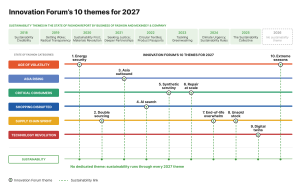
Theme lines: Business of Fashion and McKinsey, The State of Fashion 2026. Ten predictions from Innovation Forum.
1. Energy security
The war on Iran largely stopped shipping through the Strait of Hormuz, a route for around a fifth of the world’s oil and around 20% of global liquified natural gas supply. Asian production is especially exposed, since much of its textile processing runs on imported gas. In Bangladesh, the shortfall has cut garment output by 30% to 40%.
Energy sources have been a continued focus for sustainability teams, so these disruptions provide urgency to the transition to clean energy, but there needs to be alignment in the transition, as well as local context considered. One energy source commonly being used to help transition is biomass but there’s disagreement as NewClimate Institute argues biomass is too scarce to scale and electrification should come first. Sustainability teams need to engage suppliers on their energy roadmaps and support the option that suits each region’s energy mix.
2. Double sourcing
Tariffs redrew the sourcing map in 2025, and the energy crisis of 2026 further exposed how vulnerable fashion’s just-in-time model is to disruption in a single country. Brands are double or triple sourcing to keep delivery flexible. For instance, China+1 is an increasing trend: the 2026 USFIA benchmark reports that China’s share of US apparel imports fell below Vietnam and Bangladesh.
With 51% of apparel emissions in tier 2 alone (Apparel Impact Institute),the opportunity to shape a new improved sourced network could be an opportunity for sustainability teams. Sustainability teams that work with procurement on supplier scorecards can secure long-term contracts for core suppliers and use them as the incentive to finance net-zero investment. But it is also worth noting that lower volumes make it harder for suppliers to justify a new boiler or new worker welfare plan.
3. Asia outbound
Asia is now the centre of global economic growth: the IMF estimates the region will contribute 68% of global growth in 2026. Its fashion groups are following that growth and expanding west. This year, Anta Sports bought a 29% stake in Puma for €1.5bn.
These groups can bring a different culture and approach to sustainability. Many Asian groups have grown with less reporting regulation and a stronger focus on innovation. But with more cultural exchange, there’s an opportunity to learn from one another’s approaches and collaborate more closely to solve shared challenges. This can also be seen in the textile recycling context as in October, US-based recycler Circ and Chinese manufacturer Huafon announced a polycotton recycling site in China, and China has set targets of a 30% textile recycling rate and 3m tonnes of recycled fibre by 2030.
4. AI search
Consumers are increasingly outsourcing decisions to AI, trusting it to recommend what to buy and reshaping the purchase pathway. In March, Gap became the first major fashion retailer to announce checkout inside Google Gemini. Yet Business of Fashion has reported that AI answers on which brands are sustainable often differ from the evidence.
For sustainability teams, that means more rigour and more evidence around claims to avoid government crackdowns. The EU’s Empowering Consumers for the Green Transition Directive has applied since 27 September 2026 and covers products already labelled or on shelves, so claims on existing stock face questions of legality and origin. Sustainability and marketing teams will need to work more closely.
5. Synthetic scrutiny
“Polyester” has become Gen Z’s insult for anything fake or low quality, and Europe’s summer heatwaves have prompted questions about a shift to cotton and linen. Consumers are looking at labels with greater attention but switching away from virgin synthetics will lag, because perceived performance and price still drive fibre choice.
Durability may be a more nuanced lens for sustainability teams to use in the context of the cost-of-living crisis and advance more responsible consumption. Consumers increasingly judge value by how long clothes last, not just the cheapest. A University of Leeds and WRAP study of 47 T-shirts found price was no guide to durability: synthetic blends often performed well, yet four of the ten most durable shirts were 100% cotton. Sustainability teams can use durability testing to steer preferred fibre uptake with evidence.
6. Repair at scale
Resale keeps growing: in France, Vinted now sells more clothing by volume than any other retailer. Repair is now also accelerating quickly. Outdoor brands lead, with Patagonia aiming to quadruple annual repairs to 100,000 by 2028, and other categories are catching up. For instance, Primark has run more than 730 free repair workshops across nine markets.
Making repair feasible at scale requires huge inter-departmental collaboration, whether with operations teams or marketing teams to increase customer engagement. Repair also keeps customers engaged beyond the point of purchase, one of the strongest arguments to bring to finance teams.
7. End-of-life overwhelm
Clothing production continues to accelerate, with global apparel consumption projected to rise 63% by 2030, and collection infrastructure worldwide is not equipped to deal with it. Europe is a telling case: its exports of used textiles tripled between 2000 and 2019, to almost 1.7 million tonnes, mostly to Africa and Asia.
As volumes compound and responsibility for end of life moves to producers, it will be a compliance issue for brands and retailers. EU member states must transpose textile EPR into national law by 17 June 2027. While national fragmentation remains a concern for compliance teams, there’s an opportunity to model potential fee exposure by product line now to demonstrate the importance of preferred materials and updated design principles.
8. Unsold stock
Global disruption is squeezing inventory productivity. Tariffs, the energy crisis and the latest drought-related restrictions at the Panama Canal, which pushed traffic through the Strait of Magellan up more than 70%, have all made lead times harder to predict.
At the same time, since 19 July 2026, large companies have been banned from destroying unsold clothing and footwear in the EU and must report the volumes they discard, so there’s stronger scrutiny on excess production.
Sourcing teams will be under pressure to ensure agility in fast-moving lines and stability in basic products. Targeting steadier lead times and placing more emphasis on upto-date forecasting will cut the need for markdowns so there’s a real opportunity to confront the wastage around overproduction.
9. Digital twins
Digital twins have been developing for years. EON, which gives garments a digital identity, won the H&M Foundation’s Global Change Award in 2017. The technology is now moving into manufacturing, where virtual versions of fabrics, samples and production lines let teams test changes before they reach the factory floor. That cuts samples and waste and opens additional opportunities for AI-supported innovation. But twins are only as good as the data behind them, and major challenges around data quality and data interoperability remain.
However, it also raises questions about people and data control. Fashion is a tactile and heavily manual industry, and workers will need reskilling as digital tools reach the factory floor. A digital divide remains earlier in the value chain, where many tier 2 and tier 3 suppliers lack the systems to take part, and suppliers serving several brands are often asked for the same data through several incompatible platforms. There are significant opportunities for stronger alignment to reduce data duplication requests, for instance the One Retail Hub initiative, but these require considerable cooperation.
10. Extreme seasons
Flooding and heat now disrupt production annually. Floods in Bangladesh in 2024 roughly halved knitwear output, and four major sourcing countries could lose up to US$65.8 billion in export earnings by 2030 from heat and flooding. Exposed factories risk becoming stranded assets, and workers feel it first: in Phnom Penh, days at 35°C or above rose from 35 a year in the late 2000s to 112 between 2020 and 2024.
Extreme heat is an urgent question for sustainability teams looking at worker safety but questions remain around how to frame ‘the business case’. Cornell’s research in Dhaka found cooling measures could pay back within one to four years, while the Fashion Producer Collective has questioned the study: it argues the findings overlook differences between factories and rest on cost assumptions that do not hold for many sites. In the next year, aligning on who shoulders the burden of heat stress and takes the lead to ensure worker safety will be a greater focus.
Redesigning the business case
Each trend lands in a different department, from energy in operations to EPR in finance. That gives sustainability teams a hook in each, and a business case adjusted to each department’s priorities can show the long-term value of a more transparent, circular and fair fashion industry.
While the arguments exist, pulling them into a cohesive business case with the right partners takes energy, resources and a lot of shared best practice.
At the Sustainable Apparel and Textiles Conference in Amsterdam on 21 and 22 April 2027, we will look at how to build an evidenced and convincing argument for this work at a time of competing budget pressures. You can read more insights from our 2026 events at our key briefing below.
Author details


 Apparel


 Podcast

 Webinar