 Article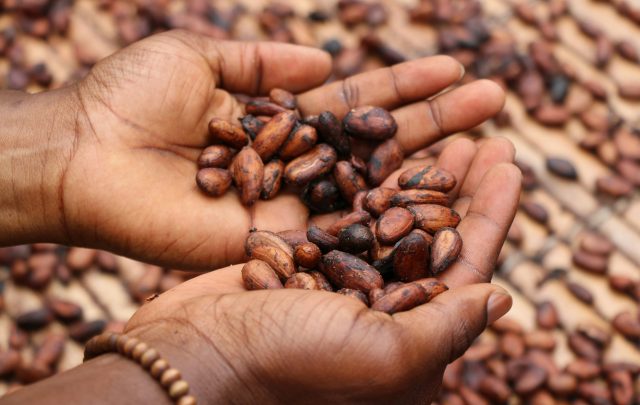
The recent crash in cocoa prices has hit west African growers of the commodity hard as the crop continues to be subject to boom and bust cycles that leave many smallholder farmers exposed. In Cameroon, reports say that prices have fallen from 5,000 Cameroon francs per kilo to 700. In the regulated markets of Cote d’Ivoire, farm gate prices are set centrally but many Ivoirian growers find themselves unable to sell at that price when the international market has dropped.
Forest NGO Fern has released research that blames a number of factors for the price drop. Good levels of supply at the same time as the chocolate sector has been developing non-cocoa alternatives because of previously high prices have in parallel hit prices. The delay in the implementation of the EU’s deforestation regulation is also a factor, Fern says. Cocoa production has of course long been linked with heavy deforestation in west Africa.
EUDR, along with similar legislation in the UK, is potentially an opportunity to transform market dynamics and farmer incomes – preventing further deforestation could help stabilise production. Traceability schemes can help farmers retain ownership of data and visibility of who benefits and by how much in often opaque value chains.
Consumer concerns
Environmental and ethical considerations have entered the mainstream for the apparel sector. That’s one of the headline findings in the latest Sustainability and the Consumer report from fashion news specialist Drapers. Researchers surveyed 2,000 UK consumers and their work reveals, Drapers says, strong consumer intent on sustainability, with more than 8 in 10 saying it matters to them or influences purchasing decisions. Nearly a quarter of respondents said that sustainability influences most purchases.
However, anyone thinking that this is nothing new but that the proof of the pudding will be in actual sales will be unsurprised to learn that consumer behaviour is still predominantly shaped by economic pressures, price sensitivity, plus uncertainty about language and what sustainability means in practice. Product quality and durability rank the highest decision-influencing factor at 86% of respondents, just ahead of price and style. Another positive point highlighted in the report is that circular fashion is gaining traction, with over 50% of consumers buying or selling used clothing in the past year. This trend is particularly strong among younger consumers. Retailer take-back schemes and resale models are highlighted in the report as areas of growth.
KitKat heist
Nestlé has reported that 12 tonnes of KitKat chocolate bars were stolen in transit between an Italian factory and Poland. The truck carrying over 410,000 KitKats apparently vanished en route. Nestlé says that the vehicle and contents are unaccounted for. The missing bars are potentially traceable via unique batch codes and anyone scanning them would receive information about how to contact Nestlé.
The company says that it has gone public with the detail about the theft to highlight what it calls an increasingly common criminal trend. Thefts of consumer goods in transit are on the rise – and food and beverage shipments are being targeted because of ease of resale and relative lack of traceability. In a sector typically with very tight margins, the loss of significant cargo can present a real challenge when alongside higher commodity prices and other supply chain pressures.
Language matters
A common theme across Innovation Forum events over the past year has been discussion about what the best language is to describe sustainable business, in particular tackling climate change, and how this is changing. A new report in news website Grist highlights the challenges that this can present for workers in US federal agencies when submitting reports and publishing research. Rather than using the term “climate change”, softer language such as “elevated temperatures”, impacts on “soil health” and “extreme weather” has become prevalent.
The Grist report highlights that for federal researchers studying the relationship between, for example, climate and disease in soy crops, they should frame the results so the politics are removed with focus on the disease rather than the climate conditions causing it. Other language around “resilience” has become more common for researchers seeking grant funding from US federal sources. A number of terms have effectively disappeared including talking about diversity, equity and inclusion, and environmental justice.
China powers ahead
A lack of grid infrastructure is hindering the roll out of electrification and the availability of power for EVs and, in particular for the growth of AI centres in the US. A Bloomberg Green report finds that the build out of AI in the US will increasingly, at least in the short to medium term, be reliant on equipment from China. There is plenty of cash available for AI data centre investments – Bloomberg highlights $650bn from Alphabet, Amazon, Meta and Microsoft in 2026 alone. However, almost 50% of data centres planned for this year are likely to be delayed or even cancelled, in large part because of a lack of available transformers, switchgear and batteries.
The US lacks the capacity to keep up with demand, with site constructors turning to Chinese imports. While the cost of electrical infrastructure is typically less than 10% of a data centre, it is impossible to build and operate the facility without it. China dominates supply of equipment essential to the energy transition because it controls many parts of the supply chain, materials, processing and manufacturing.
Author details


 Metals
 Packaging
 Cross-sector
 Webinar
 Podcast
