Webinar
In brief...
At this Innovation Forum webinar, sponsored by Bureau Veritas, speakers from Unilever, Ahold Delhaize, Nudie Jeans and AITrack Solutions (Bureau Veritas) talked through what it takes to get product carbon footprints (PCFs) past the pilot stage. Supplier capability and data quality took up much of the hour, along with how PCF work is changing supplier relationships.
Shifting expectations
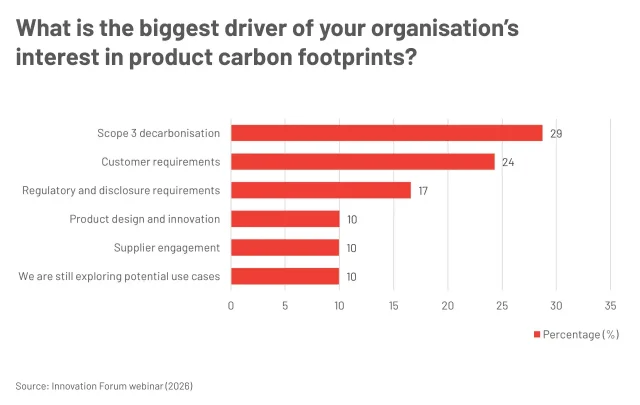
Ahead of the discussion, the audience was asked what most drives their interest in PCFs. Scope 3 decarbonisation led with 29%, customer requirements followed on 24%, and regulation trailed at 17%. That didn’t surprise Sarah Boyd, chief strategy officer at AITrack Solutions, Bureau Veritas. In her experience, what gets a company on the phone to a provider like hers is usually a customer asking for data. Regulation is murkier, and many US firms have settled into ‘wait and see mode’, though companies close to the French market have already had an early look at digital product passports (DPP).
For Ahold Delhaize, scope 3 was the catalyst for PCFs and Alex Russo, manager of supply chain decarbonisation, noted that the company started earlier this year, applying it across its whole food range. She noted that it was difficult to demonstrate any progress with standard emission factors. One methodology now lets the retailer see what a change of ingredient, packaging or farming practice is actually worth.
Boyd spent a decade working in life cycle assessment (LCA), including firsthand experience with traditional, one-product-at-a-time approaches. Companies now want footprints across whole portfolios, and AITrack’s approach can produce thousands in two to three months.
Structuring and understanding your product data is the first step for any company and for any approach to Life Cycle Assessments (LCA).
The practical bottlenecks
Unilever, which started with PCF in 2022, has already hit most of these walls. Sai Gadamsetty, its global procurement leader for decarbonisation, pointed out that across roughly 180 countries, supplier capability and even working culture vary enormously. Supplier replies picked up once requests came from the buyer who owns the relationship. These replies arrived in ‘all sorts of different metrics’, so Unilever standardised around the PACT methodology, and climate clauses now make a PCF the default for suppliers in its programme.
Ahold Delhaize doesn’t use PCFs to pick suppliers, and Russo still gets a real mix of responses. Some suppliers are short of people, some are fielding similar requests from other customers, and some worry about commercial sensitivity. Her approach is to ‘meet the suppliers where they are’, usually on a one-to-one call. Nudie Jeans held supplier webinars before gathering any data so suppliers knew why it mattered.
Russo checks quality by looking for outliers against similar products and asking the supplier what’s behind them. Eliina Brinkberg, climate and environmental manager at Nudie Jeans, compares each supplier year on year and spot-checks invoices. Gadamsetty admitted supplier PCFs have pushed parts of Unilever’s scope 3 baseline up. If real activity data is behind an increase, it stays in. ‘It’s not like you pick and choose,’ he says.
It’s absolutely essential that if a PCF request is going out, it’s going out from the person who owns that relationship on the procurement side.
Moving from pilots to portfolios
Unilever’s first two years focused on testing with a small pool of committed suppliers, and only after that did it sort the wider base by maturity. Gadamsetty credits procurement owning the work from day one, and sees linking carbon data to enterprise resource planning (ERP) systems as the next frontier.
On the other hand, Nudie Jeans has reported yearly emissions since 2019, roughly 70% now on primary data, and footprints every product at each of its four collection launches a year.
When it came to tools, the panellists kept stressing flexibility. Gadamsetty suggested using whatever platforms suppliers already know, so long as the methodology is consistent. Boyd looks for activity-based data and tools that can mix approaches, with spend-based methods kept for the long tail. She also flagged a common gap: PCFs often sit with a sustainability sub-team, cut off from the corporate footprint, and work much better on shared platform and process.
Turning data into action
At Nudie Jeans, product-level data feeds an annual one-to-one with each supplier. Brinkberg had got back from Tunisia the day before the webinar, where the brand has helped finance rooftop solar at its biggest denim supplier.
The misunderstanding, I would say, is that the fibre is playing a very big role in the emissions, but it’s very much the suppliers that you choose to work with and their fuel use and their electricity use.
One audience member asked bluntly why suppliers should bother if PCFs don’t feed into buying decisions. The panel kept coming back to resilience. This summer’s heatwaves in Tunisia overheated transformers and led to state power cuts, Brinkberg said, and Turkish suppliers face rising prices and an unreliable grid, so their own solar gives them ‘a security in their production’. Russo said better traceability now shows Ahold Delhaize which crops face climate-related yield risks.
A single number won’t get buyers far, though. Gadamsetty wants PCFs broken down by energy, feedstock and land use change so procurement teams know where to push. Nudie Jeans shows customers total CO₂ and water use per product but avoids comparisons with other brands. ‘It can be very much like comparing apples and pears,’ Brinkberg said.
Looking forward
The common thread throughout the conversation was clear. Despite varying sectoral operations across food, consumer goods and apparel, the challenges and problems were similar. Key conclusions included:
- The importance of transparency
- Knowing what suppliers are dealing with
- Climate to join cost, quality and service as a pillar of procurement
The standards are already shifting, with SBTi and GHG Protocol updates breaking down how LCA at scale fits into corporate inventories. As for worries that new methods will complicate assurance, Bureau Veritas knows that ground well as an auditor and verifier. Companies have taken LCA-based inventories through assurance for years, Boyd said, so it is ‘something that you shouldn’t be afraid to use’.
The panel


Alex Russo is a supply chain decarbonization manager at Ahold Delhaize. Her areas of focus are decarbonization strategy, supplier engagement and climate-related risk. Alex is currently working on the company's transition to product carbon footprints with a view to increasing supply chain transparency and resilience. Prior to Ahold Delhaize, Alex worked as a sustainability consultant at EY, advising companies on sustainability strategy, transition planning, greenhouse gas accounting, and sustainability assurance.


Sarah is Chief Strategy Officer at AITrack Solutions by Bureau Veritas (formerly Aligned Incentives), where she leads corporate reporting and strategy engagements and product LCA innovation. Prior to joining Aligned Incentives, Sarah led product carbon footprinting for new product introductions at Apple. At Sphera and thinkstep, Sarah worked internationally with clients across sectors and developed LCA data for the GaBi LCA database. Her book Life-cycle Assessment of Semiconductors has served as a widely-used source of environmental impact data for electronic chips. She holds a Ph.D. and M.S. in Mechanical Engineering from University of California, Berkeley, and a B.S. in Product Design from Stanford University.


Global procurement and sustainability leader with 10+ years of experience driving enterprise transformation across the US, Europe, India, and Southeast Asia. Currently leading Unilever’s global Scope 3 decarbonization for procurement, including the Supplier Climate Programme, engaging top suppliers to translate net zero ambition into supplier level action, contracts, and measurable emissions reduction. Driving climate integration into global procurement by building buyer capability and embedding decarbonization into sourcing, contracts, and commercial decision making. Partnering with Supply Chain, R&D, and Business Groups to align strategy and execution. Experience spans M&A value creation, large scale energy transition, and global supply chain decarbonisation, bringing a distinctive combination of commercial, technical, and sustainability expertise.


With a background in business, environmental science and global studies, Eliina started at Nudie Jeans in 2013. Since ten years back she is working as Climate & Environmental Manager. Eliina leads Nudie Jeans’ climate initiatives, including emissions mapping, building roadmaps for ambitious reduction targets, as well as creating internal knowledge and strategic directions on climate actions across various departments. Eliina’s responsibilities extend to areas of work covering chemical and water use, as well as biodiversity.
Ian Welsh is an expert sustainable business commentator, editor and facilitator. His prime areas of focus are business and sustainability issues, including FMCG supply chains for brands and retailers, commodities, deforestation and other climate-related risks, and human rights and modern slavery issues. He has 25 years writing and editing experience in magazine publishing and corporate communications – specialising in business, sustainability and environmental issues – including five years editing Ethical Corporation magazine.
Hosted by


 Cross-sector




 Article

 Podcast