Article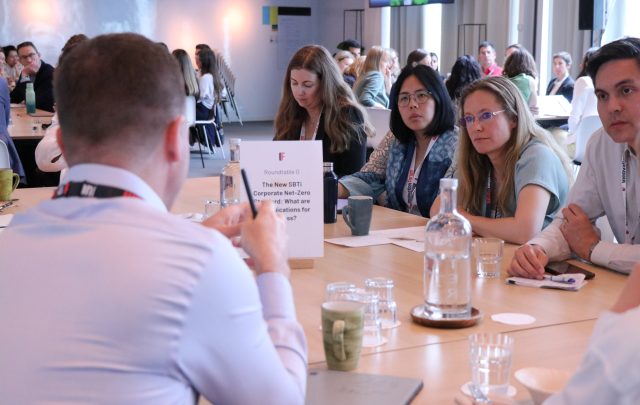
The closing session of this year’s Scope 3 Innovation Forum in Amsterdam brought all seven roundtable chairs on stage for a rapid debrief. These sessions run under Chatham House rules, and they’re where the conference gets its edge. Less polish than the panels, more admission of what’s actually stuck. Supplier engagement, internal governance, industrial heat, AI, the new SBTi standard. A few threads ran through all of it.
Start with the middle-sized suppliers
The session on engaging difficult suppliers, chaired by a sustainability lead from AB InBev, prompted strong debate on the instinct to go after the biggest names first. A large buyer is often a small slice of a big supplier’s business. That limits real influence. Medium-sized suppliers tend to engage more, because the relationship matters more to them.
Two other problems came up again and again. Data formats don’t match: companies ask suppliers for the same information but in different templates, which similar industries could fix by working together. And trust is thin. Competitors are reluctant to collaborate around shared suppliers, even when it would help everyone. The fix the group landed on was small and specific: find one supplier willing to make a first change, show the value it creates across the chain, and let that pull others in.
Make scope 3 sound like finance
The session on embedding scope 3 across the business, chaired by a former sustainability director, split the problem into external and internal routes. Externally, public targets and competitor pressure both help make the cost of inaction visible to leadership. Internally, the more durable fix is translation. Take the sustainability goal and restate it in the metrics and language finance or procurement already use, rather than asking them to learn a new one.
The barriers were discussed openly. Most organisations already have C-suite backing and some governance in place. What’s missing is institutionalisation beyond the handful of people currently pushing it. Externally, tier two suppliers are the hardest layer to reach, and upfront decarbonisation costs are often too high for any single supplier or buyer to carry alone, especially where several companies share one off-taker. Working pre-competitively to unlock capital at that level came up as a likely theme for next year.
Heat is the next big supply chain problem
The session on industrial heat was led by the Renewable Thermal Collaborative’s Europe director. Heat sits in scope 1, and it used to be lumped in with scope 2 under SBTi reporting. That’s changing, and the group expects it to push heat much higher up the agenda. The technology to deal with it already exists: electrify what can be electrified, and use biomethane, market-based certificates and biomass for the rest.
The harder problem, again, is getting suppliers to act. One idea that came up more than once: recognition works. Public supplier awards were described as a genuinely effective way to get suppliers invested in their own progress.
Rethinking what ‘emerging markets’ mean
The roundtable on emerging markets, chaired by a consultant from Rooted, started by questioning the terms themselves: emerging markets, global north, global south. The group challenged the assumption baked into those terms, that poorer economies will simply follow the same consumption path wealthier ones did. Deforestation came up as a sharp example. Much of the world’s remaining untouched forest sits in these regions, and current value chains rarely pay to protect it.
On opportunity, the strongest point was that local knowledge tends to outperform imported solutions, with technology brought in to support that knowledge rather than override it. China’s success in driving down the cost of solar was cited as proof that cost curves can move fast. Telecoms, AI, energy and transport were named as the four areas with the most near-term potential.
Where AI actually helps with scope 3
The session on AI, led by a sustainability programme manager from Picnic, mapped out where AI earns its keep on scope 3 work, and where it doesn’t. The strong use cases: assigning emission factors to secondary data, running a first-pass hotspot analysis, and pre-filling supplier information such as SBTi and CDP submissions so engagement takes less time. A less obvious one came up too: using AI to stress-test an argument before taking it to finance or procurement, since it’s genuinely good at building financial models.
The caution was on data quality and assurance. Rules-based automation has its place, but the group agreed any time saved by AI needs to be weighed against the risk of baking errors into the underlying data.
SBTi 2.0: more questions than answers
In the final roundtable, SBTi’s Europe regional lead walked through early reaction to the new corporate net-zero standard. Two issues dominated. First, how will auditors be trained on the new standard, and will they apply it consistently. Second, the new “implementation hierarchy”, which for the first time allows companies to count emissions reductions using chain-of-custody models such as mass balance and book-and-claim, rather than requiring direct traceability through the supply chain. The room had plenty of questions about how that will actually work. The standard’s real test will be implementation, not publication.
The connecting thread
The tools and the reporting frameworks are largely there. What’s missing is internal alignment to act on them, enough trust between competitors to collaborate on shared suppliers, and finance to get tier two and heat decarbonisation moving. The conversation continues at the Climate Resilience Innovation Forum in New York City, 2-3 December.
Author details



 Cross-sector





 Podcast