Article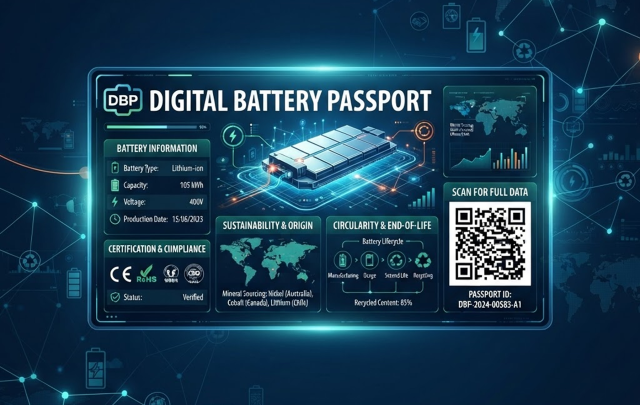
In brief...
From 2027, battery passports will be mandatory in the EU for EV and industrial batteries — requiring verified data on carbon footprint, material composition and supply chain due diligence across the full value chain. For an industry where data is fragmented, supply chains span dozens of jurisdictions, and transparency stops well short of the mine, the question is no longer whether to comply. It is often whether compliance is actually possible.
The challenge is structural: miners, processors, traders, manufacturers and brands all hold different pieces of the data puzzle, with limited incentive to share it and significant barriers to doing so. Meeting the regulation’s requirements demands a level of cross-chain coordination that the sector has never achieved at scale.
A recent Innovation Forum webinar brought together expert voices from across the critical minerals value chain to discuss exactly that.
- Anna Fleming, programme manager – critical minerals, Ellen MacArthur Foundation
- Jeroen Hoff, chief sustainability officer, Connect Bus
- Ilya Gasparishvili, digital product passport lead, Honeywell Technologies
- The discussion was moderated by Ian Welsh, co-founder and chair, Innovation Forum
What follows is a summary of the conversation.
Requirements and shortfalls
The EU Battery Regulation aims to build battery value chains that are sustainable, ethical and safe. From 18 February 2027, a digital battery passport becomes mandatory for EV and industrial batteries, bringing traceability, responsible sourcing and compliance data together in one place.
In addition to the battery passport, regulation also sets recycled content quotas for manufacturers as well as material recovery targets for recyclers. Together with some forthcoming design requirements, this comprehensive legislation checks all the boxes for a circular economy framework.
However, and going back to the digital passport, the sector is behind schedule. Many companies still treat the passport as a spreadsheet behind a QR code and early demonstrations offer only generic due diligence information. It is enough for early pilots, but it is not what the product passport requires.
Moreover, there is a serious bottleneck concerning data availability and standardisation across the supply chain.
Data gaps and coordination challenges
Distance from the source is a central problem. An electric bus contains on average 30,000 to 50,000 components, however, bus operators have little leverage over global manufacturers. Multiple stakeholders contribute in some capacity to the battery passport, however these use different definitions as well as attitudes towards the regulation, and some have a more flexible approach than others.
While the EU expects increased visibility, some actors within the supply chain might move in the opposite direction, which can jeopardise traceability. This poses a real concern about the success of digital battery passports, since the companies responsible for the passport often do not generate the data. It will be specially challenging for small and medium European manufacturers buying from larger suppliers since these do not hold a strong influential power on reporting formats. Most European battery manufacturers are small and medium-sized organisations, so this challenge affects much of the sector.
On another note, China’s move towards a localised data system could implicate an added layer of complexity, since it may clash with the EU’s decentralised model. This difference also has a greater impact on smaller companies, since it is time consuming to restructure raw data and resources are more limited when compared to bigger organisations.
A long-term fix could include interoperable passports and common data standards. Beyond the fact that this solution also has its own challenges, data gaps are themselves a warning sign that all actors involved in supply chain should tackle early on.
Systems and partnerships
An efficient passport should draw data directly from source systems such as Enterprise Resource Planning (ERP), Building Management System (BMS) and other enterprise systems, from supply records and compliance documents, reporting who supplied each figure and tracking its origin. This requires a data flow that is not currently available, but that may also lack trustworthiness.
However, EU market access gives suppliers a strong incentive to cooperate, since manufacturers outside Europe want to keep selling there. Being compliant with the EU Battery Regulation is a commercial incentive, which can potentially create a win-win situation for all stakeholders involved regarding the battery passport. Using passport readiness to assess suppliers can prove to be a successful technique to assess trustworthiness.
“Just send them a data list… and see how they respond”
The responsible use of AI is also proving to be efficient at building systems, since it can support pulling figures from compliance certificates and help prefill passport data. It can basically help you automate and scale up a process that otherwise would take you much longer.
Value beyond compliance
Digital battery passports include many benefits that go beyond compliance.
- Verifiable data can replace supplier declarations that buyers had to take on trust.
- Battery health records support reuse of batteries, while chemistry data speeds up sorting for recyclers.
- Digital service records support warranty, repair, battery-as-a-service, and leasing.
- They can provide information that supports a number of broader challenges, whether it’s on national security, social, or environmental issues.
However, as one panellist concluded, it is worth noting that passports alone will not rebuild European industry without joined-up industrial policy.
Author details

 Webinar
 Metals

 Podcast