Article
What are the key challenges for sourcing critical minerals right now?
Supply is geographically concentrated and geopolitically fragile: over 75% of global mineral production comes from countries rated unstable or extremely unstable. Demand for critical minerals is set to more than triple by 2030, yet current production trajectories fall well short, with required output increases ranging from 93% (copper) to 910% (lithium) to hit net-zero goals. Layered on top are human rights and environmental risks, water stress, and long, complex multi-tier supply chains that make traceability genuinely difficult.
How are these evolving?
Governments are responding with new or additional compliance requirements, different stakeholders in society seek for diversification of critical mineral supply. Exploration budgets are shifting hard toward critical minerals and making many companies think about optimisation of costs and prevent/reduce different risks in their value chain. Countries with critical mineral resources are tightening export controls on strategic minerals, adding a new layer of trade-policy risk. Environmental human rights, indigenous people human rights and free, prior and informed consent (FPIC) process are some of challenging areas extractive business would need to improve in the nearest future.
Volvo Construction Equipment sits in a unique position. Your machines are used in mines, and your products contain critical minerals. How does that shape your approach to responsible sourcing?
This dual exposure means Volvo must manage conflict-minerals risk in its own components while sometimes supplying the machinery that extracts those same minerals at the mine site, so responsible sourcing and responsible customer relationships (responsible sales) are two sides of one commitment. Volvo Construction Equipment applies supplier due diligence for the upstream value chain and an enhanced responsible sales programme for downstream due diligence. For the mining companies we could both be at the same time – the supplier and the customer.
What does meaningful stakeholder engagement actually look like in practice for a company with that dual exposure?
It starts with mapping and monitoring the supply chain through structured due diligence, to gather, validate and track supplier’s data, escalating non-responsive suppliers rather than treating due diligence as a one-off exercise. It also means engaging directly with mine operators as a customer and technology partner. Genuine engagement further requires transparency toward regulators, following OECD-aligned due-diligence guidance that has become the de facto global standard.
As a company, we made a commitment to responsible business conduct and the UN guiding principles. Our human rights policy informs our actions on the due diligence throughout the full value chain, and we work with a “know and show” principle that means not only to know facts but as well be able to act on it through a dialogue with our different stakeholders. Frankly, stakeholder engagement for us is a proactive process of partnering with stakeholders to ensure best possible actions and outcomes for everyone involved if any risks are identified.
How can downstream companies use their leverage to raise the bar on community engagement upstream?
Downstream firms can condition sourcing decisions on validated, conflict-free smelters and refiners identified through supply-chain due diligence, using purchasing power to steer business toward operators with stronger social and environmental performance. They can also use commercial relationships as leverage for technology and standards transfer by embedding electrification, automation and safety commitments directly into equipment and service partnerships with major miners. Finally, joining industry-wide initiatives and consortiums lets downstream companies share risk and collectively push higher engagement and sustainability standards upstream. Volvo Group and Volvo Construction Equipment are members of the Responsible Minerals Initiative.
What is the future trajectory for responsible sourcing in the construction sector?
Regulatory pressure will intensify and become mandatory rather than voluntary: the EU Critical Raw Materials Act requires large companies using strategic raw materials to identify themselves and, from 2025 onwards, conduct supply-chain risk assessments. Circularity will become a core sourcing strategy alongside primary extraction. For construction equipment specifically, we expect deeper co-innovation between original equipment manufacturers (OEMs) and mining customers on electrification and automation, alongside growing control of both the origin of the minerals in the machines and the sustainability credentials of the machines used to extract those minerals in the first place.
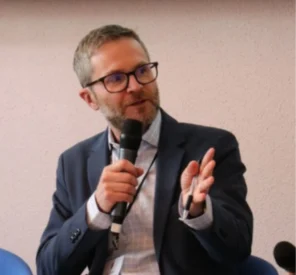
Anna Dziuba Bergfors is head of social sustainability and reporting at Volvo Construction Equipment.
Author details
Head of social sustainability and reporting



 Metals

 Webinar
 Podcast